Aquaculture
What’s in the water, pond by pond.
For fish, prawns, oysters, mussels and abalone. Follow each batch across ponds, tanks, pens and leases, from stocking through counts and water readings to harvest.
- 18 species suggested
- A pond round for your phone
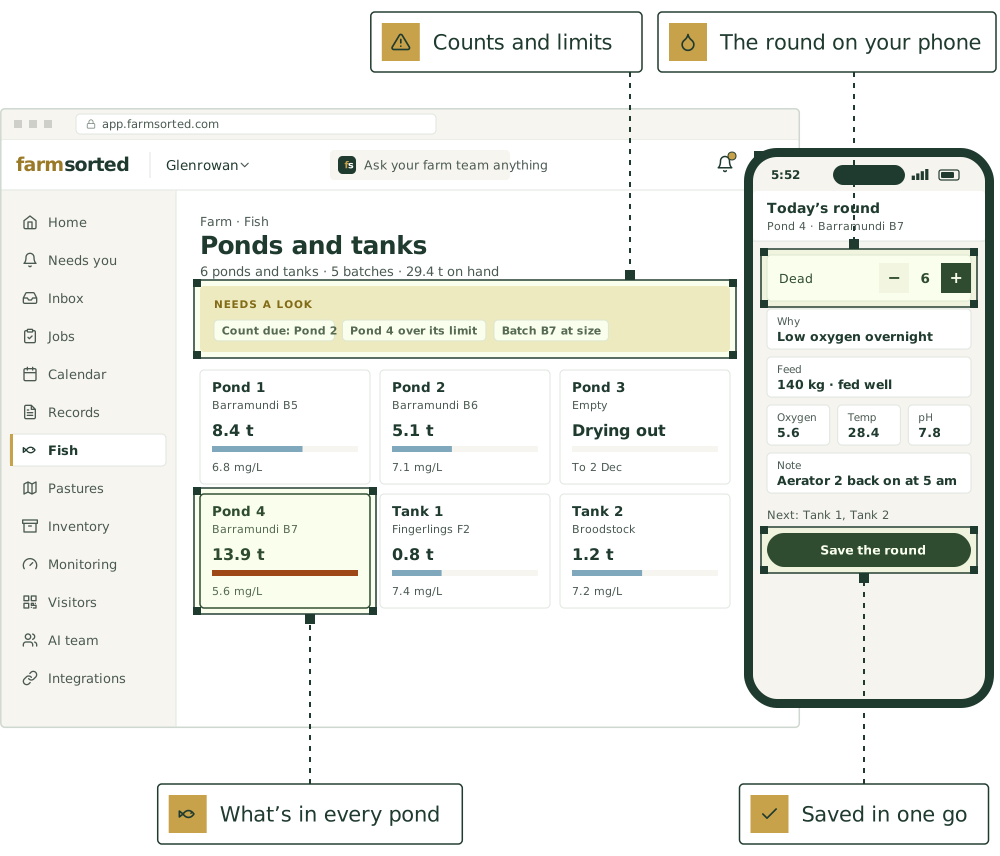
From pond to harvest
Books that follow what’s logged.
- Step 1
Set up ponds and leases
Ponds, tanks, raceways, sea pens, leases, lines, racks and bags, each with its size and the most it can hold.
- Step 2
Stock your batches
Each delivery, stocking, spat set or spawning kept. A batch can sit across several ponds.
- Step 3
Do the round
A card for each pond on your phone: deaths and why, feed, oxygen, temperature and pH. Save the lot in one go.
- Step 4
Count and harvest
A count sets the books to what you found. A harvest keeps its weight, grade, buyer and price.
Log anything
- Losses and why, feed, sample weights and counts
- Moves and grades to another pond
- Treatments and vaccines, with withholding dates
- Oxygen, temperature, pH, salinity and ammonia
- Spawnings, harvests and notes
Take any entry off and the books go back to how they were.
Stock you can stand behind
- Each species’ count and biomass now
- A count schedule, with what’s overdue first
- How far out the books were, how you counted and why
- Stock on hand on any day, as a spreadsheet for the books
Records that hold up at harvest.
Harvest area closures
Close a lease after rain or a bloom, with why and when it may reopen. Nothing on it can be harvested until then.
Withholding checked
A harvest can’t be logged while a batch is withheld, or for more than the books hold.
A page per batch
Where it is, weight against harvest size, losses by week and cause, feed to gain, and a harvest date from how fast it’s growing.
Needs a look
Counts due, a pond over its limit, a batch held by withholding, and a batch at harvest size.
Broodstock and spawning
Keep your breeding fish, and each spawning’s eggs, how many hatched and the batch the young became.
Harvest and sales
What’s coming out and when, then every harvest with its weight, grade, buyer, payment and price a kg.
Any species
Eighteen are suggested, from barramundi and salmon to tiger prawns and Pacific oysters. Type any other.
Or tell the team
Say “Pond 4, six dead, fed 140 kilos” and the team logs it, asking first.
In the morning brief
Counts due, ponds over their limit, closures and batches at size, up to five.
The agents that keep it.
Each keeps its part current, asks before anything that matters, and hands work to the others.
Biomass keeper
Stock in each pen, pond or tank: numbers, mortalities, growth samples and feed conversion

Water quality watcher
Dissolved oxygen, temperature, salinity and pH, algal blooms and alarms
Fish health recorder
Treatments, baths and medicated feed, withholding periods and aquatic disease watch
Aquaculture harvest coordinator
Harvest plans, grading, processor bookings and live and chilled transport

Lease and harvest area clerk
Lease and licence conditions, environmental reports and shellfish harvest area status
Good first jobs
Jobs the team does with it.
Log the morning fish deaths from a text
When: “42 morts in Pond 3, 6 in Pond 5.”
You get: Updated stock numbers, and a flag if a pond is above its normal rate
Spot a pen getting crowded
When: A growth sample puts a pen near its stocking limit
You get: A heads-up with the options: split, grade or bring the harvest forward
Log a bath treatment and the harvest date
When: Voice note: “Freshwater bath on Pen 3 today.”
You get: A treatment record, and Pen 3 held from harvest until it’s clear
Plan a harvest to fill an order
When: A processor emails an order for 4 tonnes of 2 to 3 kg barramundi
You get: A harvest plan, and the crew and live truck booked by email once you say yes
Log the morning pond round from a text
When: “Round: P1 5.8, P2 4.1, P3 6.2, P4 3.6, all 28 deg, pH 7.9”
You get: Readings logged by pond; ponds below limit flagged; a note of what changed since yesterday
Hold oyster orders when the harvest area closes
When: Rainfall over the harvest area’s closure trigger
You get: A warning that the area is likely closed, and a suggestion to hold orders until it reopens
Put [AGENT NAME] to work on your farm.
We’re taking a small number of pilot farms in [REGION]. Start with one or two agents and add more as you go.
See it on a farm like yours.
30 minutes with Thomas, our founder, on records like your own.
Livestock, paddocks, visitors and tanks, in one place.
The farm management software comes with every plan. Keep the software you already use, or use ours.
Not ready yet? Start with a free calculator.
The sums you do every week, for stock, pasture, crops and the books. No sign-up.
Watch a job before you commit.
Pick a playbook and see it play out, step by step.