Security
How we protect your account and your farm’s data, and how we keep the agents inside the limits you set.
Last updated 16 October 2026. [Draft: have a lawyer review before launch.]
Five layers between the AI and your farm.
Your sign-in
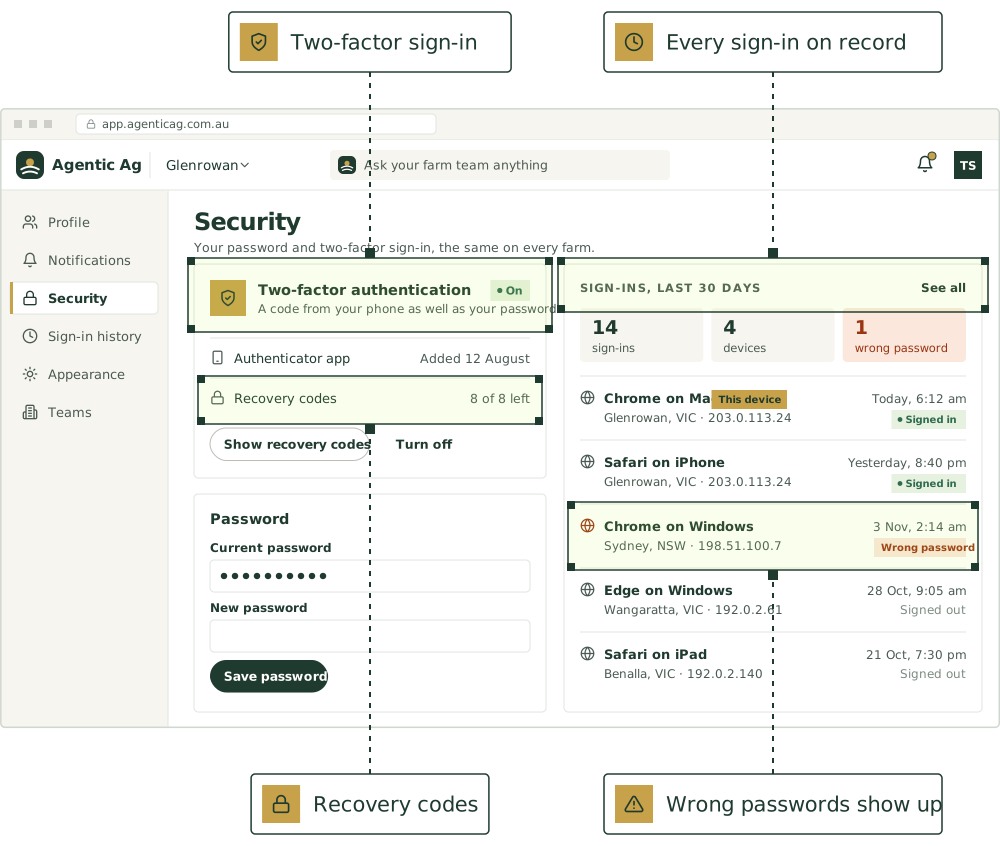
Passwords are hashed, two-factor works with an authenticator app, and every sign-in is on record.
Your people
Owner, manager, staff or advisor. What each can see and do is checked on every request.
A check before every action
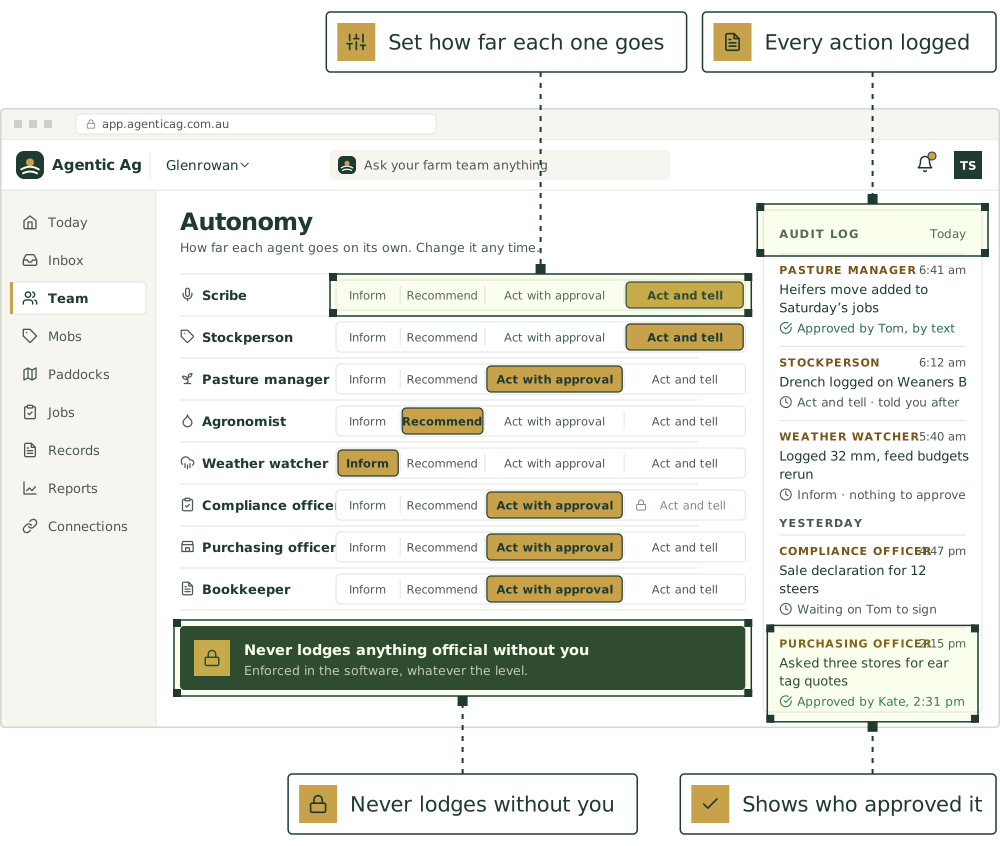
Our software checks each action against the approval level you set. The AI can’t skip it.
Outside content can’t give orders
A forwarded email or PDF can be read, but it can’t make an agent change records or contact anyone.
A second look
Automatic checks read replies after they go out, and anything that looks wrong is flagged for our team.
You can see all of this in the app.
- Sign-in history: every sign-in and wrong password on your account for the last 30 days, with the device, the place and whether it’s still signed in.
- Activity log: every job and action, what the safety check decided, and who approved it.
- Team permissions: each agent’s approval level, the actions it’s allowed, and the rules that hold whatever you set.
- Automatic checks: what each one looks for, and what it found on your farm in the last 30 days.
- People and connections: who’s on the farm and their role, and each connection with when it last ran.
1. Agents act only within your limits
Every action an agent can take has a risk level: read, draft, change records, contact people, or lodge. Before any action runs, our software checks it against the agent’s approval level and your farm’s settings. It either goes ahead, comes to you first, or is stopped.
- Lodgements with government and industry systems always ask first.
- You can set any action to always ask, pause one agent, or pause them all.
- Settings and notes can only tighten the rules. Nothing an agent is told can loosen them.
- The check runs in our software, outside the AI model, so a model can’t talk its way past it.
The full rules, level by level, are on the guardrails page.
2. When you say yes
- An action waiting for you is saved exactly as the agent asked. You can approve it, change it, or say not now. Only owners and managers can approve.
- Your yes is checked again when you give it. If the agent has been paused or turned down since it asked, nothing happens.
- If a document changes after an agent asks to email it outside the farm, the request goes out of date and can’t be approved, so you never approve something you haven’t seen.
- Two people saying yes at the same moment can’t make it happen twice.
- Nothing approves itself. Requests nobody answers are chased, then left.
3. Emails, documents, photos and links can’t give orders
Once an agent has read something from outside, such as a forwarded email, a PDF, a photo or a web page, anything that would change records or contact people asks first until that job ends. Instructions hidden in a file can be read, but they can’t make anything happen.
When an agent opens a link, it can only reach public websites. Addresses inside our own network are refused, every redirect is checked again, and very large pages are turned away.
4. Accounts and access
- Passwords are hashed, never stored as text.
- Two-factor authentication works with an authenticator app, with recovery codes in case you lose your phone. If your account doesn’t have it yet, the app offers to set it up when you sign in.
- Every sign-in and wrong password is recorded. You can see your own sign-in history, with the device, the place and whether it’s still signed in.
- Each person has a role on each farm, and permissions are checked on every request, not just hidden in the app.
- When someone leaves a farm, their access and their own connections there are removed.
- Our staff access farm data only to support you or keep the Service secure. That access is limited and logged.
5. Email, texts and calls
- Each farm’s forwarding address includes a random part, so it can’t be guessed, and you choose who can send to it.
- Emails and attachments that come in are outside content, so they can’t give orders.
- Texts and calls (coming). Calls and texts to your contacts ask first, every time. A text from a number that isn’t in your contacts is held, and no agent reads it until someone on the farm adds the sender. Anyone who replies STOP isn’t contacted again.
6. Data protection
- [Farm Data is stored in the data region your farm chose, on Amazon Web Services in that region’s city.] See data regions.
- All traffic uses TLS. Data is encrypted at rest.
- Keys for services you connect, such as AgriWebb, are encrypted. The app shows only their last four characters, and the full key never reaches your browser.
- Card details go straight to Stripe. We never see or store full card numbers.
- The activity log is kept for about 13 months, then deleted.
- [Backups: frequency, retention and restore testing.]
7. AI providers
Agents send only the parts of your Farm Data a job needs to the AI model provider. Web searches run through the same provider, limited to trusted sites for each agent. Each farm has a monthly AI budget, enforced in code, so a runaway job can’t run up costs. [Your records aren’t used to train AI models unless you opt in.]
8. Monitoring and checks
Every job and action is recorded, including what the safety check decided. Owners and managers can see their farm’s activity log at any time.
After replies go out, automatic checks read a share of them for the mistakes that matter most, such as:
- personal details showing up where they shouldn’t
- instructions hidden in an email or document that an agent tried to follow
- unsafe advice on chemicals, withholding periods or doses
- facts that your records don’t back up
Anything they find is flagged for our team, and security and safety problems reach us by email straight away. Anyone on the farm can flag a reply or a job for us to look at too.
9. If something goes wrong
If a breach is likely to cause serious harm, we’ll tell the farms affected and the Office of the Australian Information Commissioner, as the Notifiable Data Breaches scheme requires, and say what we’re doing about it.
10. Reporting a vulnerability
Found a security problem? Please tell us. We’ll reply within 3 business days. Our vulnerability disclosure policy explains how to report it and what to expect. Our contact details are also in security.txt.