Crops and blocks
What’s planted where, what it should yield, and what’s sold.
Grain, hay, cotton, rice and cane, as much as orchards, vines and nuts. Follow each crop through the season, from the first estimate to the last load.
- About 60 crops suggested
- Called Blocks on an orchard or vineyard
Through the season
From sowing to sold.
- Step 1
Set up the season
Seasons end with your harvest, from your setup answers. Apples picked February to April make a May to April season.
- Step 2
Put a crop on each paddock
About 60 crops are suggested, with their usual use, yield unit and stages. Type any other crop and it still works.
- Step 3
Log every load
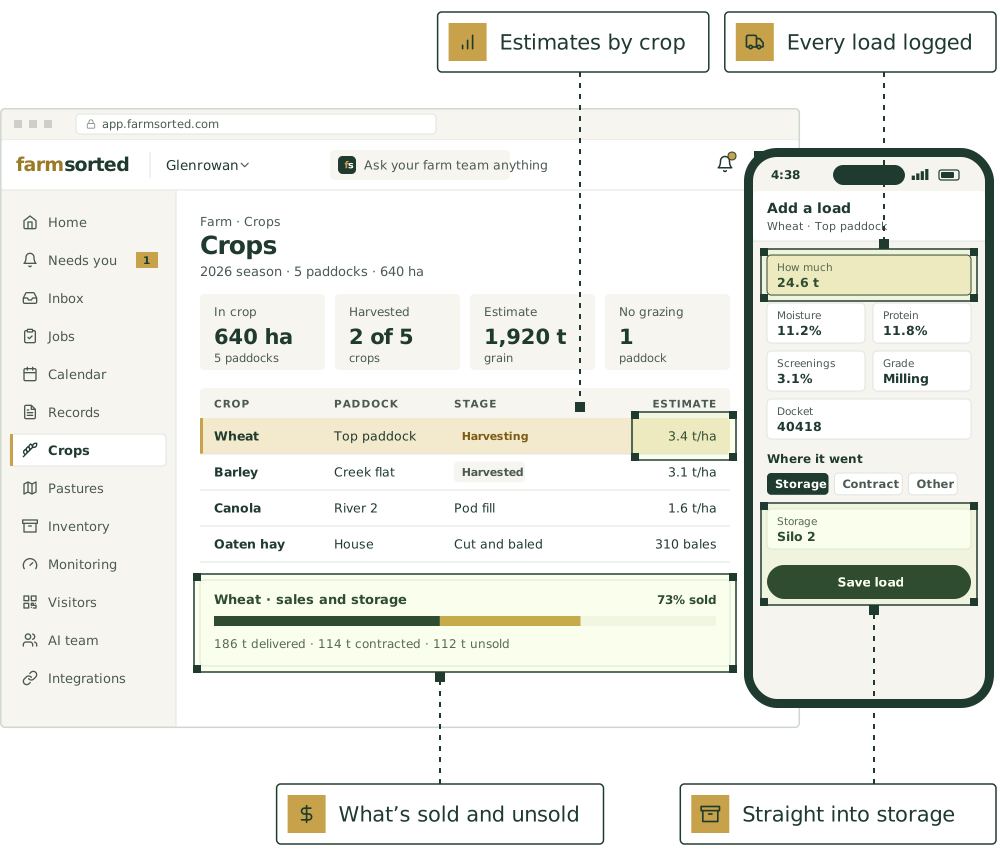
Add each load, bin or pick from the crop’s page, with its quality figures and its docket or bin tag.
- Step 4
Say where it went
Into storage, onto a contract, or somewhere else. The crop’s harvested total keeps itself up to date.
Plantings that stay in the ground
- Fruit and nut trees, vines, cane, lucerne and sown pasture
- Variety or pasture mix, rootstock or clone, and the year it went in
- How many trees, vines or plants, with rows and spacing
- Start them all gives every block its crop for a new season in one tap
Sales and storage, on one tab
- Each crop’s estimate, harvested, in storage, contracted, delivered and unsold
- The share sold, and what the unsold is worth at your price
- What’s in storage, by place
- Every contract this season, with how much is delivered and still to go
View only people who don’t see prices see the tonnes without the dollars.
The whole crop, on one page.
Every crop, at its stage
Planned, growing, harvesting, harvested or lost, with its stage in the crop’s own words, its area, sowing date and what it’s grown for.
Estimates with a history
Each new estimate is kept with the day, why it changed, and the person or agent who changed it.
Loads, bins and picks
Grain keeps its moisture, protein, screenings and grade. A pick keeps the rows and the crew.
Storage that adds up
Send a load to Silo 2, a silo bag or the cool store and it goes into Inventory. Take the load off and storage goes back.
Contracts
Forward contracts, sales at harvest, pools and supply agreements, with the buyer, grade, price, and where and when it’s delivered.
Your price today
Keep a price for each crop, with where it came from. Every one is kept.
A page per crop
Its facts, its planting, how the estimate moved, and the sprays, fertiliser and rain on its paddock that season.
What grew here before
Every paddock’s page shows this season’s crop, what’s planted for years and the crops before it.
The team asks first
Specialists can update a crop, log loads and record contracts you’ve agreed. They ask first, and they never agree to a sale.
The agents that keep it.
Each keeps its part current, asks before anything that matters, and hands work to the others.

Crop planner
Rotation, paddock plan, varieties and sowing dates

Harvest coordinator
Headers, chaser bins, trucks, moisture readings and segregations

Yield forecaster
Yield estimates from rainfall, soil water and satellite

Grain marketer
Cash bids, pools, forward contracts and basis

Grain storage keeper
Silo and bag inventory, fumigation records and grain quality
Block manager
Per-block records: varieties, rootstocks, plantings and tree counts
Good first jobs
Jobs the team does with it.
Update the yield estimate after a good rain
When: 25 mm or more recorded in the growing season
You get: Updated yield range by crop, with what it’s based on; the change in tonnes; a note for the grain marketer
Finish the right paddocks before the rain comes
When: Rain forecast inside the next 72 hours during harvest
You get: Proposed paddock order to beat the rain; hours needed against hours available; trucks to line up
Work out how much grain is in storage that isn’t sold yet
When: “How much barley have we got that isn’t already sold?”
You get: Tonnes by grade in each silo and bag; committed tonnes by contract; seed and feed held back; uncommitted tonnes by grade, and when each can go out
Warn before you fall short on a contract
When: Deliveries so far are behind what the contract needs by the end of the window
You get: Tonnes short and days left; what the contract says about shortfalls; options to talk through

A weekly note on cash bids, pools and basis
When: Friday afternoon
You get: A short weekly price note; how much of each crop is priced; any target price you set that was met
Start next year’s paddock plan once harvest is done
When: The last paddock is marked harvested
You get: Draft paddock plan; rotation breaks and plant-back clashes flagged; a list of decisions for the agronomist meeting
Use ours, or keep yours
Already use other software for this? Keep it.
Your agronomist’s plans and paddock records can sit alongside these as each connection is built.
Back Paddock
Agronomy recommendations and spray records from Back Paddock would come in alongside your records.
PCT AgCloud
Precision farming maps and machine data from PCT AgCloud would come in alongside your records.
Put [AGENT NAME] to work on your farm.
We’re taking a small number of pilot farms in [REGION]. Start with one or two agents and add more as you go.
See it on a farm like yours.
30 minutes with Thomas, our founder, on records like your own.
Livestock, paddocks, visitors and tanks, in one place.
The farm management software comes with every plan. Keep the software you already use, or use ours.
Not ready yet? Start with a free calculator.
The sums you do every week, for stock, pasture, crops and the books. No sign-up.
Watch a job before you commit.
Pick a playbook and see it play out, step by step.