Inbox and contacts
Farm mail in one place, and everyone you deal with.
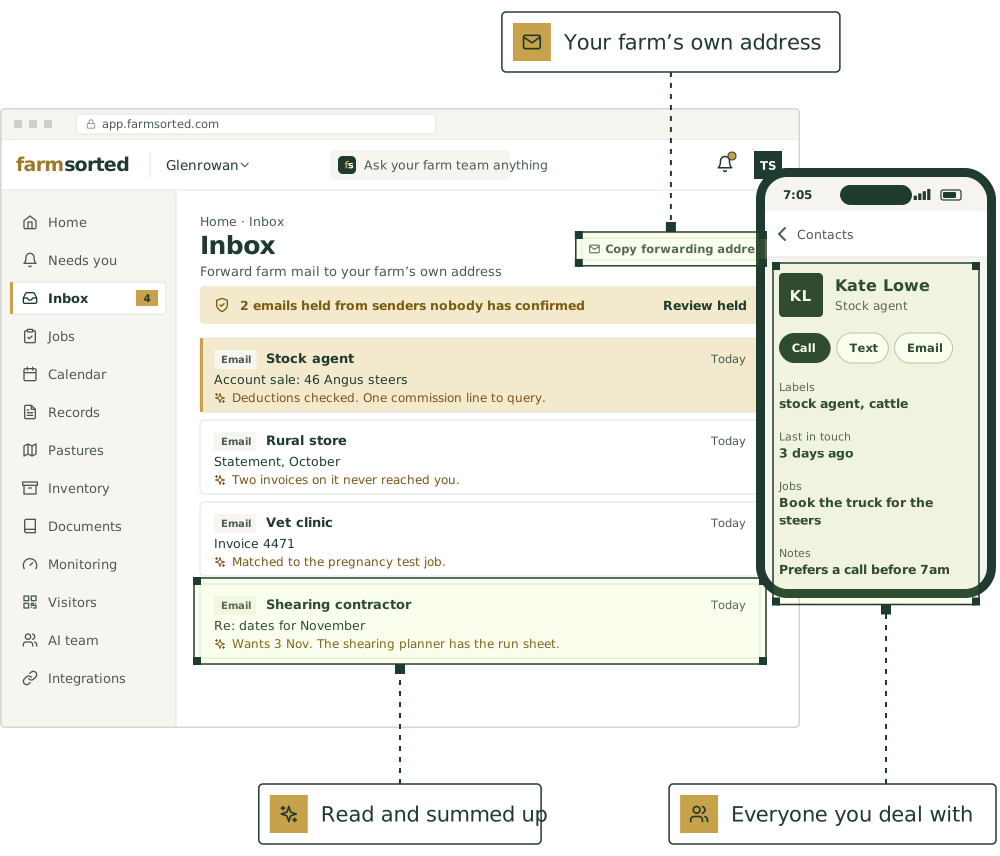
Forward invoices, kill sheets and the stock agent’s emails to your farm’s own address. The team reads trusted mail and says who should handle it.
- Your farm’s own address
- Unknown senders held
Less time in the inbox.
Your farm’s own address
Forward farm mail to it. Mail from senders nobody has confirmed is held until someone releases it.
Senders you trust
Allow or junk a sender by its address or a whole domain.
Read and passed on
The team reads trusted mail as it arrives and suggests who on the team handles it, with next steps to pick.
One contact list
People and organisations with labels, notes, logged calls and meetings, and their jobs. It shows who’s gone quiet after 90 days.
Call, text or email
On a phone each contact has Call, Text and Email in reach. Reply to an email in one tap.
Don’t contact
Mark a contact don’t-contact for email, texts or calls, and the team keeps to it.
The agents that keep it.
Each keeps its part current, asks before anything that matters, and hands work to the others.

Inbox clerk
Reads forwarded email and PDFs: invoices, account sales, kill sheets, lab results

Contractor coordinator
Shearers, sprayers, carriers, vets: bookings and confirmations

Bookkeeper
Codes bills and sales to the right enterprise

Document drafter
Writes farm documents from your records
Good first jobs
Jobs the team does with it.
Sort out a forwarded email chain
When: A long email thread from your stock agent forwarded with “sort this”
You get: Sale date and mob listing ready for your okay; questions back to you
Match an invoice to the job it paid for
When: Vet invoice forwarded to the farm inbox
You get: Cost ready to go on the right mob; the scan result beside it
Check the deductions on an account sale
When: An account sale (the stock agent’s statement of a sale) arrives
You get: All clear, or a note on what doesn’t match and a draft query to the stock agent
Check the rural store statement against the invoices you got
When: The monthly statement from [rural store] lands in the farm inbox
You get: Statement ticked off line by line; the lines that don’t match; a note ready for you to send asking for the missing invoice and credit
Find the receipt and warranty for something that’s broken
When: “The pressure pump at the house dam’s died. Is it still under warranty?”
You get: Invoice, warranty terms and install date in one place; time left on the warranty; serial number and the supplier’s claim contact
Book and chase contractors
When: “Get the spreader in before the rain”
You get: Booking emailed after your yes; on the plan once they confirm; a nudge if nothing comes back
Use ours, or keep yours
Already use other software for this? Keep it.
Forwarded email works today. Here’s where the other ways in are up to.
Inbound email
Forward invoices, kill sheets, NVDs, soil tests and emails from your stock agent to your own farm address. The team reads each one, sums it up and suggests who handles it.
Calls and texts to your contacts
Once it’s connected, ask in any agent chat and it rings or texts the people you deal with: book a truck, chase a quote, confirm a delivery. Before you say yes, you see who it will call and what it may agree to, every time. Replies and call-backs come to your farm number.
Once it’s connected, you can message the team on WhatsApp the same way you text, with voice notes, photos and forwarded messages.
Google and Outlook calendars
Once it’s connected, scanning, shearing, contractor and audit dates will appear on the calendar you already use.
Put [AGENT NAME] to work on your farm.
We’re taking a small number of pilot farms in [REGION]. Start with one or two agents and add more as you go.
See it on a farm like yours.
30 minutes with Thomas, our founder, on records like your own.
Livestock, paddocks, visitors and tanks, in one place.
The farm management software comes with every plan. Keep the software you already use, or use ours.
Not ready yet? Start with a free calculator.
The sums you do every week, for stock, pasture, crops and the books. No sign-up.
Watch a job before you commit.
Pick a playbook and see it play out, step by step.