Eggs and meat birds
The daily shed sheet, and what it tells you.
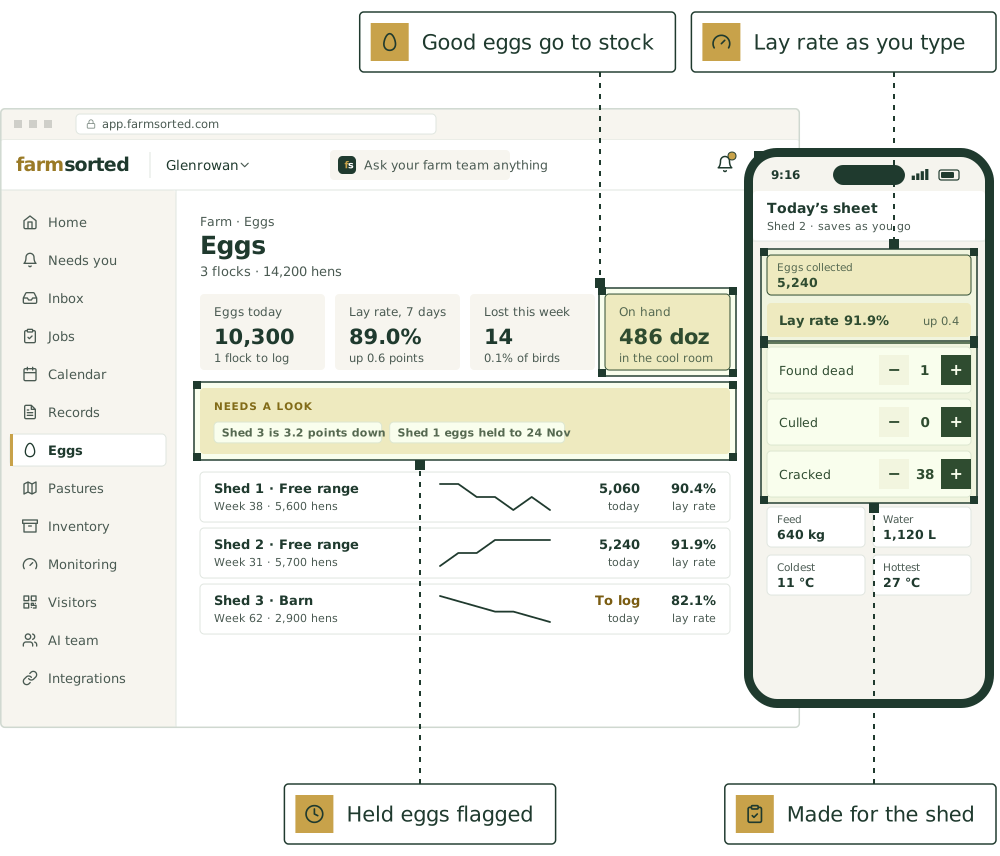
For laying flocks and meat bird batches of any kind. Log the day on your phone in the shed, then see lay rates, losses, egg stock and what’s due.
- A sheet for your phone in the shed
- Any kind of bird
Each day
Log the shed, and the rest follows.
- Step 1
Open today’s sheet
A card for each flock that saves on its own. Count eggs one by one, by the tray of 30 or by the dozen.
- Step 2
Add what happened
Cracked or dirty eggs, birds dead or culled, feed, water, temperatures and a sample weight for meat birds.
- Step 3
Flocks and stock keep up
Dead and culled birds come off the flock, and good eggs go into Inventory as that day’s batch.
- Step 4
See what needs a look
A flock 3 points or more under last week, unusual losses, held eggs, and dates in the next 14 days.
For laying flocks
- Lay rate by week of age, and the last 7 days against the week before
- Eggs on hand, oldest first, with last week’s sales by how they were sold
- Standing or one-off egg orders, with when each is next due
- Birds a hectare on the range
For meat birds
- Birds on the farm, the share lost and the average sample weight
- The next thin or clear-out
- Sheds over time: each batch from placement to clear-out, 8 weeks each way
- Kilograms a square metre against the shed’s limit
Know how every flock is going.
Any bird
Chickens, ducks, turkeys, geese, quail, guinea fowl, emus and ostriches, or type your own. Each gets its own words and egg count.
Eggs held for withholding
A treatment on a laying flock asks when its eggs can go. Until then they’re counted but kept out of Inventory.
Sheds
Up to 200 sheds, barns, caravans, tractors, yards and pens, with how the birds are kept, the floor, and how many it holds.
A page per flock
Its shed, its numbers by week or by batch, birds lost each day, the last 14 sheets and every record on it.
Stock and sales
Each kind of egg from collected to packed, sold and thrown out. Selling names the buyer and how it was sold.
Or tell the team
Say “Shed 2, 5,240 eggs, one dead” and it fills in the sheet, changing only what you said. It asks first.
The agents that keep it.
Each keeps its part current, asks before anything that matters, and hands work to the others.
Lay rate watcher
Hen-day production, egg weights and grading by flock
Egg standards clerk
Egg stamping, free-range stocking density and Egg Standards of Australia records
Batch tracker
Each batch from placement to sale: mortality, weights and feed conversion

Shed climate watcher
Shed temperature, ventilation and alarm feeds
Good first jobs
Jobs the team does with it.
Flag a flock dropping off lay
When: Hen-day production down for three days running
You get: A note on what changed; a question to the vet if nothing explains it

Hold eggs from a flock under an egg withholding period
When: A flock treatment is logged with a withholding period on eggs
You get: Egg WHP end date for the flock; a hold note for the shed and grader; daily trays held; release date in the records
Spot a batch falling behind
When: A batch’s weights or feed conversion slip behind your target curve
You get: A note with the gap and what’s changed, such as feed, health or the shed
Check free-range density when a flock moves
When: A flock is moved to a new shed or range area
You get: Density for the new range; a flag if eggs from it can’t be called free range
Sum up a batch when it’s sold
When: The last pickup for a batch
You get: Batch summary: mortality, average weight, feed conversion; compared with the last few batches

Get ready for the next thinning
When: Three days before a thinning pickup
You get: Thinning checklist; times listed; a Thursday heads-up to pull feed
Put [AGENT NAME] to work on your farm.
We’re taking a small number of pilot farms in [REGION]. Start with one or two agents and add more as you go.
See it on a farm like yours.
30 minutes with Thomas, our founder, on records like your own.
Livestock, paddocks, visitors and tanks, in one place.
The farm management software comes with every plan. Keep the software you already use, or use ours.
Not ready yet? Start with a free calculator.
The sums you do every week, for stock, pasture, crops and the books. No sign-up.
Watch a job before you commit.
Pick a playbook and see it play out, step by step.