Many farms have a biosecurity plan because their assurance program asks for one. It’s easy for that plan to be a template, filled in once, filed and forgotten. That ticks the box. It doesn’t do much when a truck from three districts away pulls up at the yards.
A plan you use is short, specific to your place, and written so a casual could follow it. Here’s how to get there.
Start with a template, then make it yours
There’s no need to start from a blank page. The Farm Biosecurity website, Integrity Systems Company (ISC) and your state department all have templates. Pick one, then cross out anything that doesn’t apply and add what’s specific to you. Your state may have its own requirements on top, so check with the department.
What it should cover
- A map. Property boundary, house, yards, sheds, and where visitors and vehicles can and can’t go. Mark the one entry point you want people to use.
- People and vehicles. Who needs to sign in, where they park, and what they do before going near stock: clean boots, clean vehicles, no stock contact without a reason. “Come clean, go clean” is the short version.
- Incoming stock. What you ask for before they arrive, such as the vendor declaration and a health declaration, how you check them on arrival, and how long they’re kept separate before they join the main mobs. Agree the isolation period and any treatments with your vet.
- Outgoing stock. Fit to load, the right paperwork, and loading from the boundary where you can, so the truck doesn’t drive through the place.
- Feed and water. Where bought-in feed comes from, its vendor declaration, and how it’s stored away from vermin and wildlife.
- Pests and weeds. Which ones you watch for, how you record sightings, and who you report them to.
- Animal health monitoring. What gets recorded (sick animals, deaths, abortions, anything unusual) and when you call the vet.
- Emergencies. What to do if you suspect an emergency animal disease: stop movements, isolate, and call the Emergency Animal Disease Hotline on 1800 675 888 or your vet.
Keep it to a page people will read
The full plan can be as long as it needs to be. But put a one-page version where people will see it: on the shed wall, in the ute, in the induction for new staff. It should say:
- Where visitors go and who they call
- What to do with new stock
- What counts as “ring the boss now”
- The emergency numbers
If a new casual can’t tell you what’s on it after their first week, it’s too long.
Make the visitor log easy
A visitor log is one of the most useful records in a disease trace and one of the most neglected. A clipboard at the gate that nobody fills in is worse than useless, because it looks like a record. Make it easy: a sign with a number to text, a QR code, or a book in the place people actually stop. Record who, when, where they went on the property, and where they were before.
Review it when things change
Look at the plan at least once a year, and again whenever something changes: you buy from a new area, take on agistment stock, put in new yards, or there’s an outbreak in the district. Compare what the plan says with what happened. If you’ve been doing something different, either change the plan or change what you do.
How your AI team helps
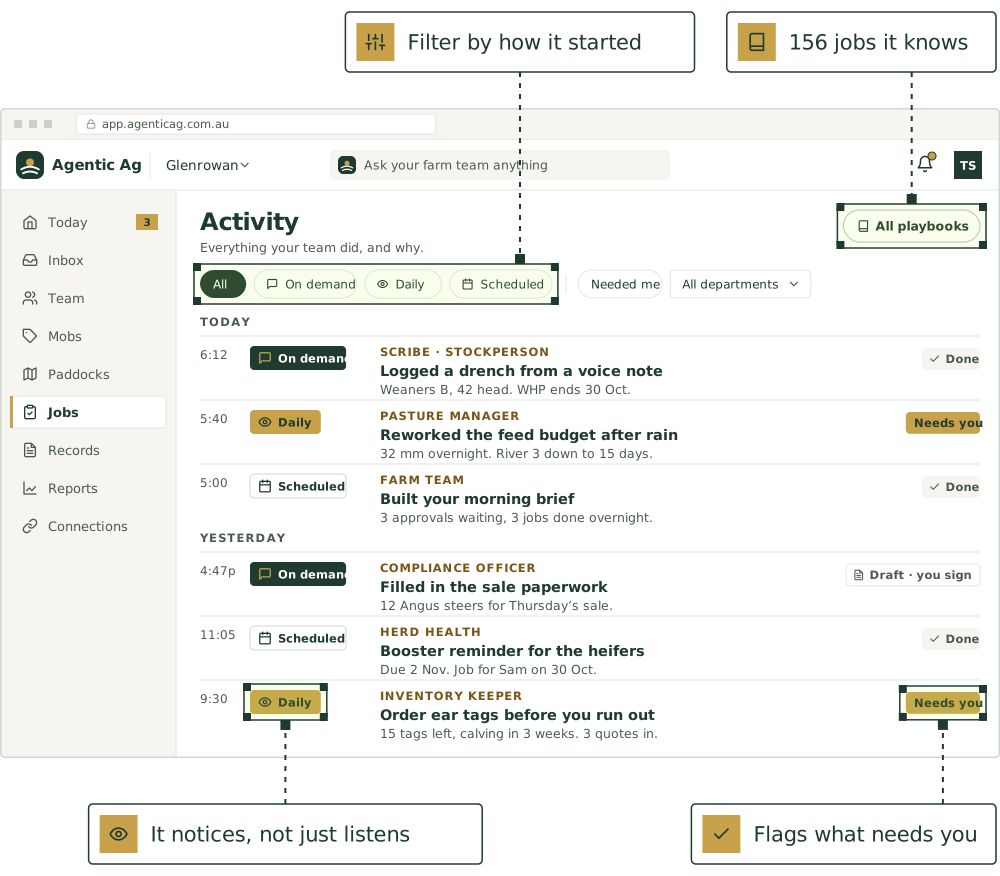
Once a year, or when something changes, the Herd health and biosecurity agent compares your plan with what actually happened: visitors, purchases, outbreaks. It sends you a marked-up plan to approve. Visitors can be logged by text to [AGENT NAME] at the gate.
When new stock arrive, it checks the health declaration, suggests a quarantine paddock and arrival treatment for you to confirm with your vet, and reminds you until they join the main mob. If a disease alert comes through, it lists every animal, vehicle and visitor in and out over the last 30 days, so the trace list is ready for the vet or the department. It doesn’t diagnose anything. That’s your vet’s job.