Every drench, pour-on, vaccine and pasture spray comes with numbers that decide when stock can be sold for slaughter. They’re easy to lose track of across six mobs and three products.
Here’s what the numbers mean, how to count them, and how to keep them straight without a calendar on the fridge.
What each number is
- Withholding period (WHP). The minimum time between the last treatment and slaughter for human consumption, or collecting milk or eggs. It’s set on the label as part of the product’s registration with the national regulator, the Australian Pesticides and Veterinary Medicines Authority (APVMA), and it’s a legal requirement.
- Export slaughter interval (ESI). The minimum time between the last treatment and slaughter for export. Some importing countries set tighter residue limits than Australia, so the ESI can be longer than the WHP. ESIs are shown on some labels and in the current ESI list published for industry.
- Grazing withholding period. For pasture and crop chemicals: how long before stock can graze the treated area or be fed the treated crop. On the chemical’s label.
- Wool harvesting interval. Some sheep lice and fly products also say how long before the sheep can be shorn or crutched. On the label.
You often won’t know where stock end up after they leave. If there’s any chance they go to an export plant, the ESI is the safer number to plan around. Your stock agent or processor can tell you what they expect.
How to count
Count from the last treatment, not the first. If a product went on twice, the clock starts at the second dose. Read how the label words it, because that’s what counts.
An illustrative example. You drench the weaners on 3 March with a product that has, say, a 14-day WHP and a 21-day ESI.
- WHP: 3 March plus 14 days. Earliest slaughter for the domestic market is 17 March.
- ESI: 3 March plus 21 days. Earliest slaughter for export is 24 March.
- Your stock agent has a sale on 20 March. That’s past the WHP but inside the ESI. You’d need to declare it on the vendor declaration that goes with the stock, and the buyer may not want them.
Those numbers are made up for the example. Real ones come from the label of the product you used, every time.
Where it catches people out
- More than one product. A mob drenched and then treated for lice has two clocks running. The later end date is the one that matters.
- Part of a mob treated. If you treat some animals and then box them back in, you need to know which ones, or treat the whole mob as being under the WHP.
- Sprayed paddocks. Stock moved onto a paddock before its grazing withholding period is up pick up the chemical’s slaughter restrictions too.
- Bought-in stock. Their treatments came with them. Read the vendor’s declaration and carry any open withholding periods onto your own records.
- Memory. Labels change when products are re-registered. Check the label in the shed, not the number you remember from last year.
What to record at the time
Assurance programs expect a treatment record for every animal treatment. Write it the day you do the job. It takes a minute then and an hour later.
- Date and time
- Product name and batch number
- Dose or rate, and how it was given
- Which mob or animals, and how many
- Who did it
- WHP and ESI, and the date each one ends
For sprays, add the paddock, the area, the weather conditions and the grazing withholding period. Your state may have its own spray record requirements, so check with the state department of agriculture.
How your AI team helps
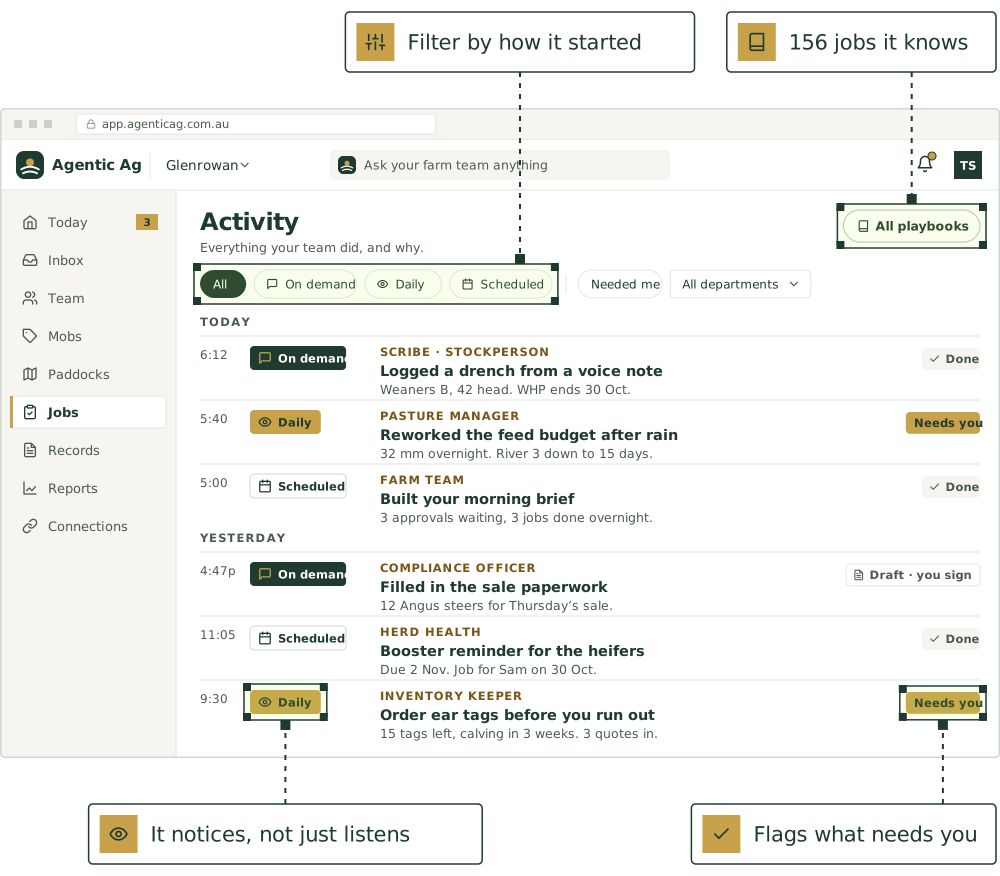
Send [AGENT NAME] a voice note like “Drenched the weaners, 140 head, [product]” and the Stockperson logs the treatment against the right mob, looks up the product’s withholding period and puts the end date on the mob. It reminds you the day before.
When that mob is lined up for a sale, the Chemical register checks the WHP and ESI against the sale date and blocks or warns before the sale declaration is filled in. It also flags stock about to go onto a paddock that’s still inside its grazing withholding period, and keeps an eye on the vet chest so products are in date. The label is still the authority. If something doesn’t look right, check the label and ask your vet.