Good rain changes the mood on a farm overnight. It doesn’t change the feed in the paddock overnight. A feed budget is how you work out what it does change, and when.
The idea is simple: feed available, plus feed that will grow, against what the stock will eat. The hard part is honest numbers, especially the growth rate. This guide walks through one paddock as an example.
The four numbers you need
- Herbage mass now, in kilograms of dry matter per hectare (kg DM/ha). From a pasture ruler, photo standards, satellite estimates you’ve checked against the paddock, or a good eye that’s been calibrated.
- Residual target. The feed you want left when the stock come off, to protect the plants and groundcover. Your agronomist or local guidelines can help you set it for your pasture type.
- Growth rate, in kg DM/ha per day. The number that moves most with rain and season.
- Demand. What the mob eats per day. Intake depends on class, weight, condition and feed quality. Get a figure for your stock from your advisor or the feed budgeting tools from Meat & Livestock Australia (MLA).
The worked example
The numbers here are illustrative, picked to make the arithmetic easy to follow. They’re not recommendations.
A mob of 120 steers is on River 3, a 50 ha paddock. Assume each steer eats 10 kg DM a day.
- Demand: 120 × 10 = 1,200 kg DM a day.
- Herbage mass is 1,400 kg DM/ha. The residual target is 1,000 kg DM/ha. Available feed: (1,400 − 1,000) × 50 = 20,000 kg DM.
- Before the rain, growth is 5 kg DM/ha a day. That’s 5 × 50 = 250 kg DM a day across the paddock.
- Net draw: 1,200 − 250 = 950 kg DM a day.
- Days of feed: 20,000 ÷ 950 = about 21 days.
Then you get 32 mm. What happens next depends on the growth rate, and pasture doesn’t respond straight away. Say it takes 10 days to kick in.
For the first 10 days, nothing changes: 10 × 950 = 9,500 kg DM eaten from the store, leaving 10,500 kg DM.
Scenario A: growth picks up to 20 kg DM/ha a day.
- Growth: 20 × 50 = 1,000 kg DM a day.
- Net draw: 1,200 − 1,000 = 200 kg DM a day.
- Remaining days: 10,500 ÷ 200 = 52.5 days.
- Total: about 62 days from the rain.
Scenario B: growth only gets to 12 kg DM/ha a day, because it turns cold or the follow-up rain doesn’t come.
- Growth: 12 × 50 = 600 kg DM a day.
- Net draw: 1,200 − 600 = 600 kg DM a day.
- Remaining days: 10,500 ÷ 600 = 17.5 days.
- Total: about 27 days from the rain.
What the example tells you
The same 32 mm gives you either nine weeks or four, depending on one assumption. That’s the point. The rain gauge tells you something happened. The growth rate tells you what it’s worth.
- Use conservative growth rates until you’ve seen the response. Season, temperature, soil type and pasture species all matter.
- Remeasure in a fortnight and rerun the budget with real numbers.
- The model is simple on purpose. Grazing affects regrowth, stock don’t eat evenly, and some feed gets trampled. Leave a margin.
- Do it across the whole farm, not one paddock. A mob that can stay put longer means another paddock gets more rest.
How your AI team helps
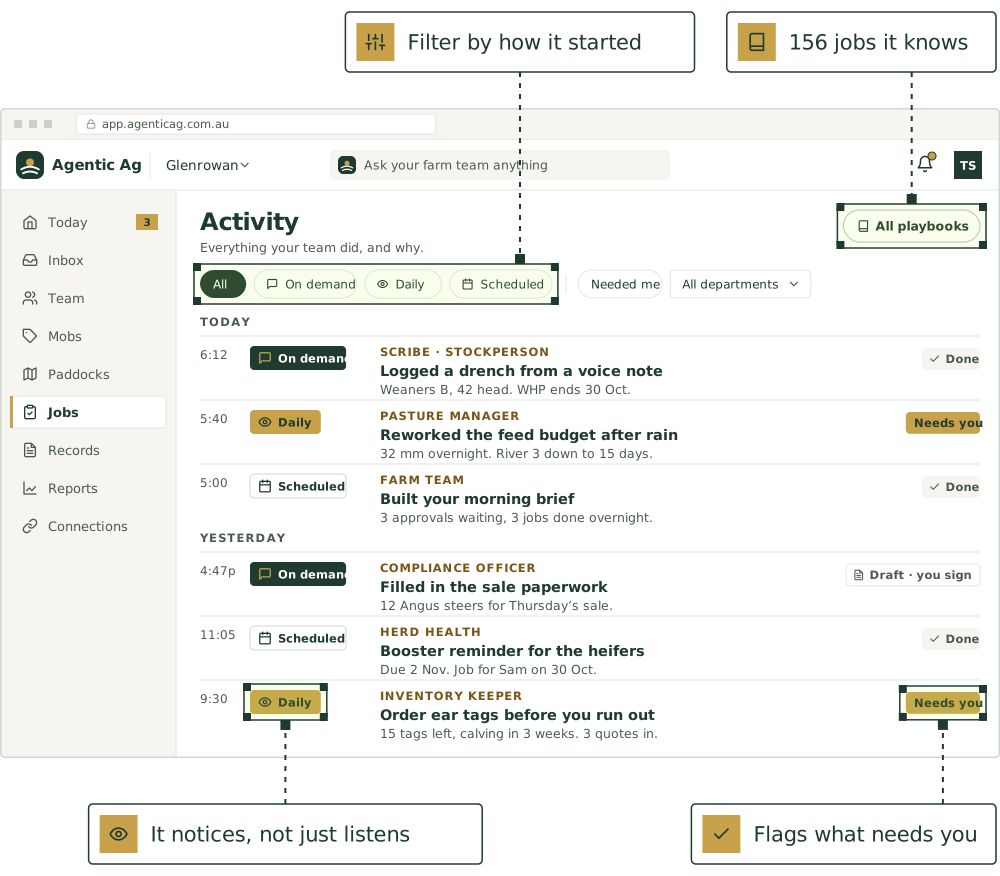
When the gauge records rain, the Pasture manager updates the expected growth and recalculates days of feed for each paddock. [AGENT NAME] tells you what’s changed: which paddocks can rest longer, which mobs can stay put. It’s set to the Inform approval level, so it tells you and doesn’t move anything on its own.
When a paddock falls below target, it proposes the next paddock for that mob, with reasons: cover, rest, water and anything sprayed. You approve the move. Text “Moved the heifers to the river paddock” and it logs the move and updates the stocking rate on both paddocks. The growth rates it uses are estimates. Your eye in the paddock, and your agronomist, are what keep them honest.