Every dry spell has a point where the options start to close. Store stock prices drop as everyone sells. Hay gets dearer and further away. Agistment fills up. Cattle and sheep lose condition and become harder to sell or move.
Deciding early what you’ll do, and when, is what keeps those options open.
Set trigger points
A trigger point is a decision made in advance: if this hasn’t happened by this date, we do that. It turns a long worry into a calendar.
If we haven’t had 25 mm by 1 April, the steers go. If we haven’t had it by 1 May, we start feeding the cows.
Those are examples, not recommendations. Set yours from your own rainfall history, your pasture types and the time of year your country usually responds. Write them down and tell whoever else makes decisions on the place. A trigger nobody else knows about is just a thought.
Know what you’ve got
- Pasture. Run the feed budget forward with low growth rates. How many weeks before each mob runs out?
- Fodder on hand. Hay and grain in tonnes, and roughly what quality. Old hay may be worth less than you think, so a feed test is worth it.
- Water. How many weeks are left in each dam and tank at summer use and evaporation, and which paddocks lose water first. Check quality too: algae and salinity get worse as levels drop. Ask your vet or the state department if you’re unsure.
- Stock. Numbers by class and their condition now.
- Groundcover. Bare ground in a dry spell is soil you lose when it does rain. Know which paddocks are getting close to your groundcover target.
Decide what goes first
Most places have a rough order for destocking. It’s worth agreeing on it before you’re in the middle of it. A common way to think about it:
- Trading and finishing stock that can be sold without hurting the breeding herd.
- Culls you were going to sell anyway: older, dry or poor-performing breeders.
- Young stock that can go on agistment or be sold as stores.
- The core breeding herd last, because it’s the slowest and dearest to rebuild.
Your order might differ. That’s fine, as long as it’s decided.
Price the options
The usual choices are sell, agist, feed, or a mix. Rough costs help, even if they’re rough. An illustrative example for feeding:
- 200 cows on hay, at an assumed 12 kg as fed per head per day: 200 × 12 = 2,400 kg, or 2.4 t a day.
- For 60 days: 2.4 × 60 = 144 t.
- At an assumed $300 a tonne delivered: 144 × 300 = $43,200, before labour, fuel and wastage.
Put that next to what selling, or agisting, would cost and return. Real rations depend on hay quality and the class of stock, so get a ration worked out with a nutritionist, your vet or an advisor. Containment feeding is another option on some places, and needs planning for the site, water and animal health.
Don’t leave it all on your own shoulders
Talk to your bank early, not when the overdraft is already stretched. The Rural Financial Counselling Service is free and independent. Your state department will have current drought information and any support that’s running. And talk to someone. Dry times are hard on people as well as stock.
How your AI team helps
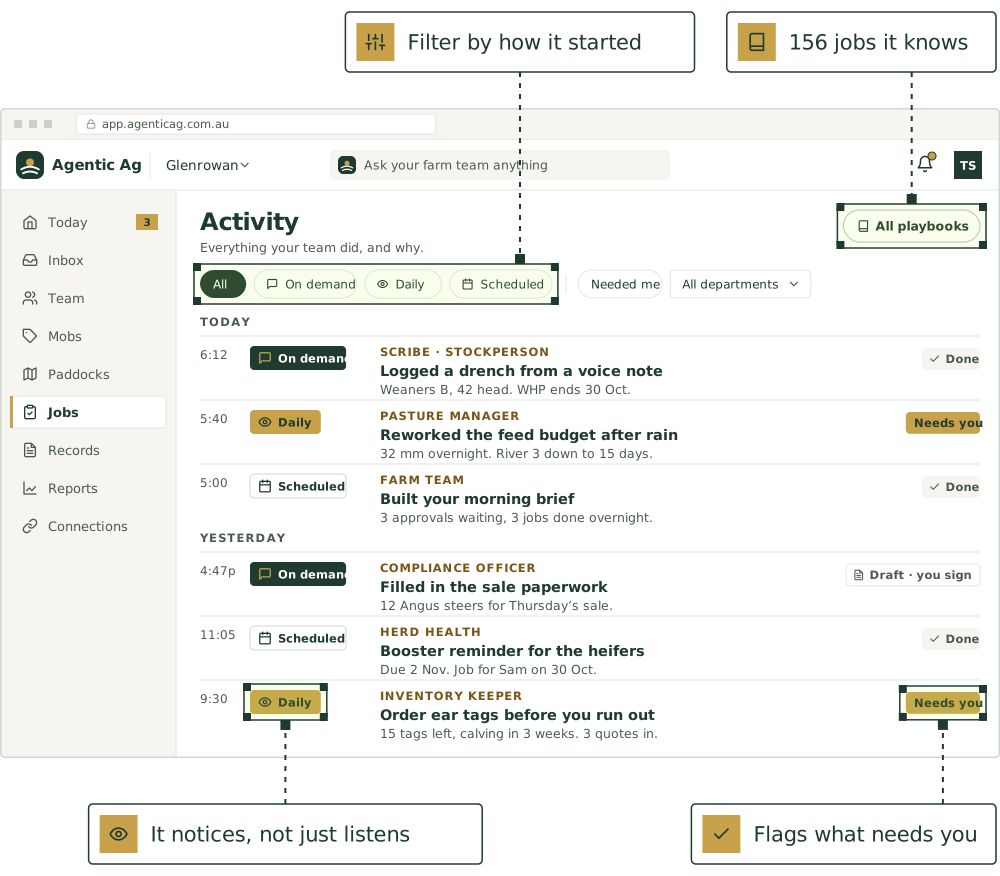
When the forecast turns dry, the Pasture manager runs the feed budget forward and flags the shortfall. [AGENT NAME] comes back with options, such as selling a mob, agisting, buying feed or destocking, with rough costs on each, for you to decide.
The Feed planner keeps count of hay and grain on hand, tells you when the hay runs out at the current feeding rate, and works out a supplementary ration for you to check with your advisor. Later, once water monitors are connected, the Water officer will check whether the stock water will last the summer. It recommends; the decisions stay with you.