“Agentic AI” is the phrase of the moment, and like most phrases of the moment it gets stretched to cover a lot. Here’s what it means in practice, on a farm, without the sales pitch.
A chatbot answers. An agent does the job.
A chatbot answers questions. You ask what the withholding period is on a product, it tells you (and may or may not be right). Then you go and write it down.
An agent is given a job and the tools to do it. It can read your records, look things up, fill in a form, set a reminder, and come back to you when it needs a decision. The AI part is the bit that understands “drenched the weaners, 140 head” and works out which mob, which product and what to record. The agent part is everything it then does with that.
“Agentic” just means it takes steps towards a goal, rather than answering one question and stopping.
It notices things without being asked
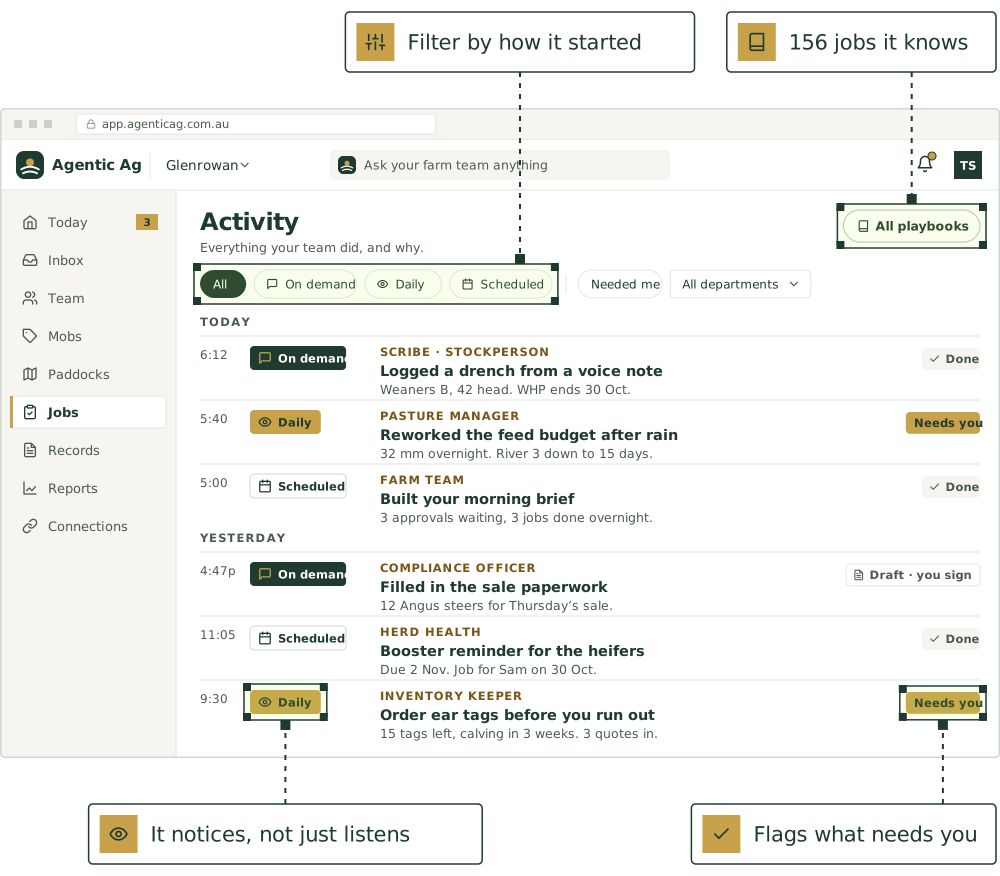
The other difference is that an agent doesn’t only wait to be asked. It can start a job when something happens: 32 mm in the gauge, a trough level dropping, an audit date 30 days out, a treated mob listed for sale. That’s the useful part: nobody has to remember to check.
It also remembers your farm: paddock names, mob nicknames, your vet, your stock agent, how you like things done. That memory is what turns “moved the heifers to the river” into a usable record.
Why a team instead of one agent
One agent asked to do everything gets muddled, and it needs access to everything. Splitting the work up helps on both counts. A specialist that only does chemical records gets good at chemical records, and it can only take the actions that job needs. The Agronomist can’t touch your accounts.
You still only talk to one. It passes the job to whichever specialist does that work, and brings back the answer.
What it’s good at
- Turning a text, voice note, photo or forwarded email into a clean record.
- Keeping track of dates: withholding periods, renewals, boosters, audits.
- Pulling scattered records together, such as the treatment history for one mob, the night before a sale.
- Noticing things in data: a rain gauge reading, a trough level, an animal off trend at weighing.
- Drafting paperwork so you check it instead of writing it.
What it isn’t
- It isn’t a vet, an agronomist, an accountant or a lawyer. It can tell you what your records say and what the label says. It can’t tell you what’s wrong with a sick cow.
- It isn’t in the paddock. It only knows what you, your staff, your sensors and your records tell it.
- It isn’t always right. It can misread a voice note, match the wrong mob, or get a number wrong. Good ones show their working so you can catch it.
- It isn’t a replacement for your judgment. Selling, buying, spraying, moving stock: those are your calls.
Questions to ask before you trust one
- What can it do on its own, and what needs my approval? Can I change that?
- Can it lodge anything with a government or industry system without me?
- Does it show where each answer came from?
- Who sees my data, where is it stored, and is it used to train AI?
- Can I get all my records out if I leave?
- What happens when it gets something wrong? Can I see what it did and undo it?
If a vendor can’t answer those plainly, that’s an answer too.
How our AI team works
You talk to [AGENT NAME]. Behind it are 149 specialists in 19 departments, each with its own job and only the actions that job needs. You set how much each one can do on its own, from Inform (it tells you, does nothing) through Recommend and Act with approval to Act and tell (it does routine jobs and lets you know after).
Whatever the level, nothing is lodged with a government or industry system without your approval, and that rule is enforced in the software, not just in the AI’s instructions. Every suggestion shows the records, rules and data behind it. Every action is logged with who approved it and when. You can turn any agent down to Inform, or off, at any time.